
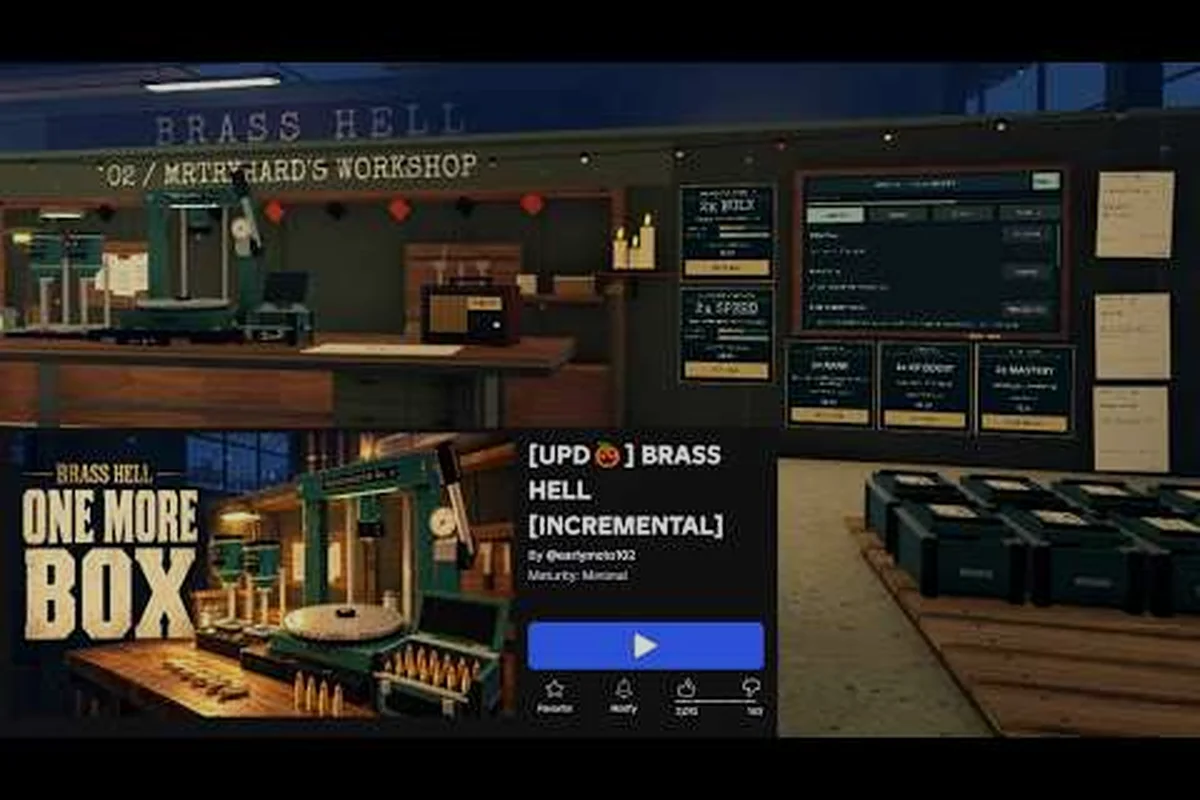
BRASS HELL gameplay basics matter because your first orders depend on a simple chain: craft rounds, pack crates, and deliver them before production slows down. Learn the press rhythm early, and you’ll avoid wasting materials while building a factory that can handle bigger orders.
BRASS HELL Gameplay Basics: Your First Production Loop
Your first goal in BRASS HELL is not to maximize output. It is to understand the complete loop: gather materials, operate the press, convert them into rounds, fill a crate, and deliver the finished order. The official BRASS HELL game page describes the opening path as a cold-facility introduction built around finding the press, making opening rounds, and preparing an early crate for delivery.
That order matters. If you begin packing crates before you understand the press, you may spend more time correcting mistakes than producing useful ammunition. Once you can repeat the basic sequence, each new upgrade becomes easier to evaluate because you know exactly where time is being lost.
The Core Actions
The core gameplay loop has four connected actions. You move between stations, interact with the press, collect the resulting rounds, and bring them to a crate or delivery station. The game’s developer profile describes the control layer as a lean set of actions centered on movement, press interaction, picking up rounds and crates, and depositing items at packing and delivery stations.
| Action | What to do | Common mistake | Better habit |
|---|---|---|---|
| Move | Walk or run between work areas | Taking unnecessary routes | Learn the shortest route between stations |
| Press | Use the press to make rounds | Interacting too quickly or with the wrong materials | Watch the press state before repeating the input |
| Collect | Pick up finished rounds | Leaving rounds scattered around the work area | Clear nearby objects after each production cycle |
| Pack and deliver | Place rounds into crates and complete orders | Delivering an incomplete crate | Confirm the required amount before leaving |
Your First-Hour Priority
Your first hour should establish a repeatable routine rather than chase every available station. Start by learning where materials begin, where the press is located, and where packed crates need to go. Player reports emphasize the same early priorities: master the press rhythm, keep crate packing active while orders are available, and bank an early workshop upgrade.
| Time | Main objective | Why it matters |
|---|---|---|
| First 5 minutes | Locate the press and gather starting materials | Establishes where production begins |
| Minutes 5–15 | Produce the first usable rounds | Confirms the basic crafting interaction |
| Minutes 15–30 | Fill and deliver the first crate | Completes the first full production cycle |
| Minutes 30–45 | Repeat the loop at a steadier pace | Reduces hesitation and wasted movement |
| Minutes 45–60 | Save toward an early workshop upgrade | Supports faster or more efficient production |
This is the core of the BRASS HELL first hour guide: learn one complete loop, then repeat it until the sequence feels automatic. A separate beginner progression guide can help with longer-term goals once these fundamentals are reliable.
Press Rounds and Manual Ammo Crafting
The press is the heart of BRASS HELL gameplay basics. Each successful cycle should create rounds that you can collect and move into a crate. Because production is manual at the start, understanding the timing and the location of spawned items matters more than trying to click as rapidly as possible.
Community gameplay demonstrates players hand-building large quantities of rounds, confirming that the early game expects active work rather than a fully automated line. That makes the press a learning tool. You can observe how materials move through the station, how long the process takes, and whether your collection habit prevents objects from cluttering the workspace.
Learning the Press Rhythm
Begin with one round at a time. Interact with the press, watch the result, collect the round, and repeat. Once that sequence is stable, attempt two consecutive cycles without walking away unnecessarily. This approach reveals the practical rhythm: preparation, activation, waiting, collection, and return to the press.
| Press stage | What you should observe | Action to take |
|---|---|---|
| Idle | The press is ready for input | Interact when required materials are available |
| Producing | The station is actively working | Wait for the cycle rather than interrupting it |
| Complete | A round is available | Move close and collect it |
| Reset | The press is ready again | Return immediately or prepare the next batch |
Manual Crafting Efficiency
The best beginner habit is to reduce travel distance. After depositing a finished crate, return to the press; after collecting rounds, bring them directly to the packing area. If a route forces you to cross the same section twice, look for a simpler arrangement. Even small travel savings add up because every spare second can become another production cycle.
-
Keep one path between the press station and the packing station.
-
Clear collected rounds before starting a new batch.
-
Watch the press during your first several cycles.
-
Group similar actions instead of alternating constantly.
-
Stop pressing when materials are unavailable; investigate the supply route instead.
Do not assume that more inputs always mean more output. A failed interaction or an abandoned round can erase the advantage of faster input. This is one of the most useful BRASS HELL essential tips: consistency comes from observing the station, not from spamming the interaction.
Crate Packing and Order Delivery
Packing turns loose rounds into sellable or deliverable goods. The station should be treated as the second half of the press: once you collect ammunition, your next objective is to place the correct quantity into a crate and route that crate to the active order. This is where production becomes a business rather than idle crafting.
The important detail is that a full factory without deliveries does not count as progress. Orders provide the purpose for your material chain, while crates preserve the output of each round-making cycle. New players often focus too heavily on production speed, but a missing delivery can undo much of that effort.
Building the Crate Correctly
Use the available station prompts rather than guessing. The game may change specific controls as development continues, but the developer profile confirms that players can pick up crates and deposit them at packing and delivery stations. Follow the interaction that highlights the relevant object and watch what quantity appears.
| Stage | Correct focus | Benefit |
|---|---|---|
| Collecting | Bring rounds directly from the press | Avoids losing ammunition during movement |
| Packing | Match the requested crate quantity | Prevents partial or overfilled deliveries |
| Preparing | Confirm the active order | Ensures the crate reaches the right destination |
| Delivering | Carry the packed crate to the delivery point | Converts production into completed orders |
| Repeating | Return to materials and press | Starts the next production cycle |
Reading the Active Order
Before filling a crate, check the order’s required item and quantity. If you pack the wrong material, the crate may still look complete but fail to advance the objective. The safest routine is to read, gather, pack, verify, and deliver in that exact sequence.
-
Required item: Confirm the order asks for rounds.
-
Quantity: Compare the crate count with the order count.
-
Destination: Follow the highlighted delivery station.
-
Completion: Wait for the order confirmation before leaving.
-
Next demand: Check whether the following order changes the material or amount.
The getting started guide is useful if station labels or controls are unclear, but the practical rule is simple: never carry a full crate away from the packing area without verifying its contents. Check each required item against the active order, watch the crate counter after packing, and confirm that the material matches the request before delivery. For example, if the order calls for two crates of rounds but the packing area still shows a crate of scrap, stop and correct the load at the station; a visually full crate can otherwise fail the objective.
Movement, Timing, and Workshop Upgrades
Movement is part of the production system, not a separate skill. Every unnecessary step consumes time that could have produced another round, and every crowded station increases the chance of missed interactions. Because BRASS HELL is built around repeated factory work, a clean route and a consistent timing pattern can improve output before you buy any upgrade.
Start by measuring one complete cycle. Move from the supply point to the press, collect a round, bring it to the crate, and return. Notice where you slow down, where you change direction unnecessarily, and whether the press ever sits idle while you are elsewhere. These observations provide a more reliable basis for improvement than simply pressing buttons more often.
A Reliable Beginner Routine
Use a three-part routine every time you leave a station: take the needed material, complete one action, and prepare the next action before moving. This reduces the chance of realizing halfway across the facility that something is missing. It also makes new upgrades easier to judge because your baseline is already organized.
| Priority | Action | Reason |
|---|---|---|
| 1 | Keep the active order visible | Prevents work on the wrong product |
| 2 | Avoid idle press time | Produces more rounds from the same materials |
| 3 | Deliver completed crates promptly | Converts inventory into progress |
| 4 | Store supplies near the press | Reduces repeated long-distance trips |
| 5 | Upgrade only after measuring the bottleneck | Avoids solving a problem you do not have |
When to Buy the First Upgrade
Player reports recommend banking an early workshop upgrade, but the exact purchase depends on your current bottleneck. If you spend most of the cycle walking, a mobility or layout improvement may help more than faster production. If you constantly wait for the press, investigate production speed first. If crates accumulate because deliveries are slow, improve that route before adding output.
Before spending, compare three costs: the materials tied up in the upgrade, the travel time consumed by your current production route, and the attention lost while the workshop or press is idle. For example, if a faster press saves four seconds per order but the layout adds six seconds of walking, the press upgrade may not be the better first purchase; trace a complete order cycle before choosing.
-
Materials: How much inventory the upgrade consumes?
-
Travel: How many seconds does the current route waste?
-
Attention: Are you losing rounds, missing orders, or standing idle?
That comparison creates a much better BRASS HELL full guide foundation than blindly purchasing the first available option. The learning the game overview provides a broader framework for tracking improvements, while your own cycle measurements show which upgrade will produce the best return.
Common Beginner Mistakes and Better Alternatives
Most early failures come from skipping the verification step. Players craft plenty of rounds, yet still fall behind because they pack the wrong amount, deliver to the wrong station, or leave supplies scattered around the factory. These mistakes become more obvious when each stage is treated as a separate checkpoint.
Diagnosing a Slow Session
When production feels inefficient, observe the factory for one minute instead of changing everything immediately. Count how often the press completes a cycle, whether you collect each result, and how long a crate remains ready for delivery. This simple audit reveals whether the limiting factor is input, output, packing, or transportation.
| Symptom | Likely bottleneck | Corrective action |
|---|---|---|
| Press waits for materials | Supply or movement | Gather a batch and shorten the return trip |
| Rounds remain near the press | Collection habit | Collect immediately after each cycle |
| Crate cannot be delivered | Quantity or destination | Recheck the active order and station prompt |
| Many crates, few completed orders | Delivery speed | Deliver before continuing production |
| Production improves only after buying | Missing upgrade | Compare measured time costs before purchasing |
Better BRASS HELL Beginner Tips
-
Keep the press area clean so finished rounds remain easy to see.
-
Use the crate prompt as a final check before leaving the station.
-
Avoid carrying materials to several unfinished destinations at once.
-
Make the first order before attempting a large batch.
-
Revisit the official game page when controls change, because this early-access release may receive updates.
-
Use community footage to compare your routine with an experienced run, not as a substitute for testing the current version.
The strongest BRASS HELL essential tips are simple but easy to neglect. Confirm the objective, work one station at a time, and keep the route between production and delivery short. Once those habits are stable, you can add speed without creating confusion.
Your First Hour Checklist
A successful first hour ends with a working production routine and a clear understanding of your next upgrade. You do not need maximum output; you need enough consistency that every action supports the next one. Use this checklist to test whether you have learned the core BRASS HELL gameplay basics or whether one weak link is slowing everything down.
| Checkpoint | Complete when… |
|---|---|
| Press mastery | You can produce and collect several rounds without confusion |
| Material awareness | You know where supplies begin and when they run low |
| Crate control | You pack the requested quantity and verify it before leaving |
| Order delivery | You complete the opening order through the delivery station |
| Route efficiency | Your production-to-packing path has few unnecessary turns |
| Upgrade planning | You know which part of the loop wastes the most time |
A Reliable First Session
Start with the order on screen, gather what it needs, and operate the press until you have enough rounds. Pack the crate, verify the contents, deliver it, and immediately check the next objective. If your materials run low, return to the supply point before trying to improve speed. Once an upgrade becomes affordable, buy the one that addresses your measured bottleneck rather than the most expensive option.
That routine is the difference between random activity and controlled progress. In BRASS HELL, treat the workbench, supply point, press, crate, and delivery marker as one production chain: every completed action should create the next task without forcing a full reset. For example, if a delivery requires brass parts, queue the correct material at the supply point, operate the press, and confirm the crate before moving on. The game’s early challenge comes from linking these separate actions into one continuous flow, so a failed order usually points to a broken link in your setup rather than random bad luck.
Frequently Asked Questions
What should I focus on first in BRASS HELL?
Focus on completing one full production cycle: craft rounds at the press, collect them, pack the requested amount into a crate, and deliver the order. Learning this sequence prevents the most common early bottleneck, which is producing ammunition without converting it into completed orders.
How many rounds should I make before packing a crate?
Make enough rounds to satisfy the active order, then stop and verify the required quantity before depositing them. Producing extra can be useful, but early beginners often lose time by crafting beyond the request or failing to collect every finished round.
Should I buy an upgrade immediately in BRASS HELL?
No. Watch your first production cycle and identify the real bottleneck first. If the press is idle because of travel, improve that route; if materials are missing, fix the supply process; if delivery is the problem, prioritize the packing and delivery route before purchasing speed.
What is the best way to organize the factory early on?
Keep the main route between the press, crate, and delivery station short and clear. Store supplies near the press, collect rounds as soon as they appear, and verify crates before carrying them away. A simple layout makes each upgrade easier to use effectively.
Can I automate production in the BRASS HELL first hour?
Manual production is the central part of the opening experience, so do not rely on automation during the first hour. Focus on mastering the press rhythm, crate packing, and order delivery. Once those actions are reliable, you can evaluate upgrades and future production improvements without hiding a weak foundation.