
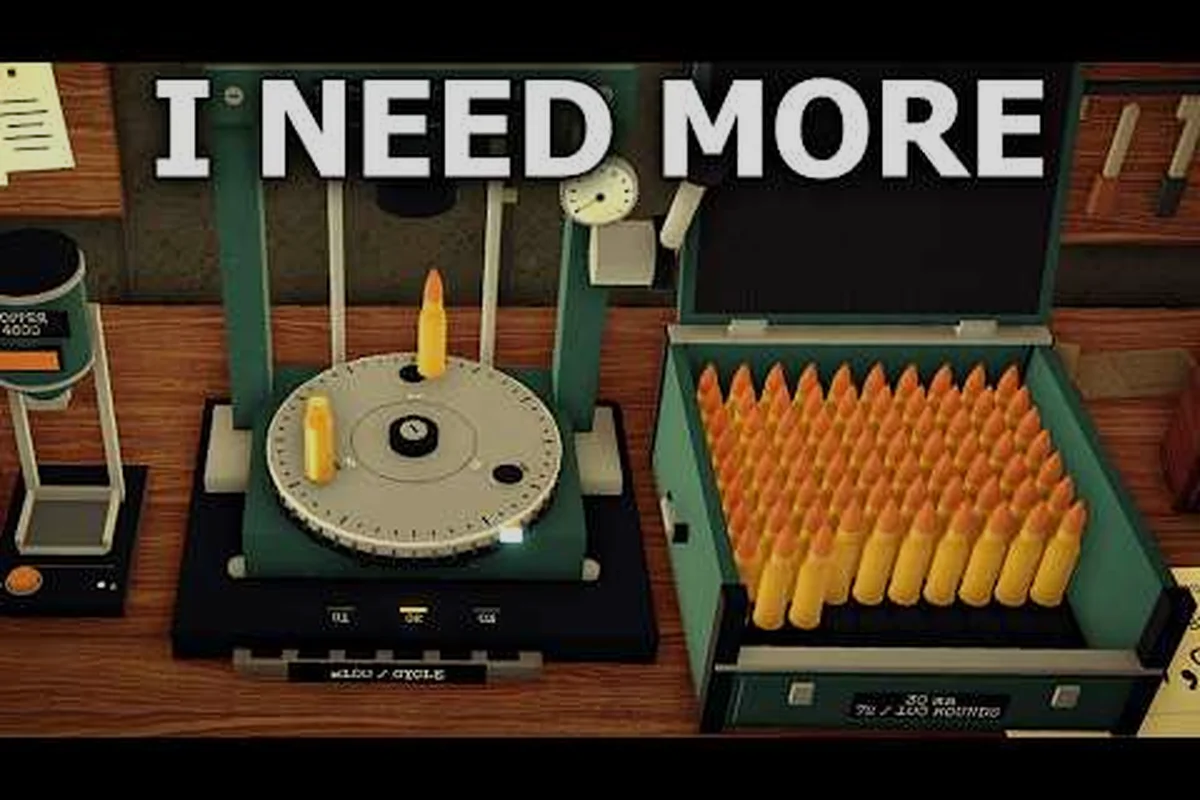
BRASS HELL learning the game starts with one goal: turn raw material into a completed order without breaking your factory rhythm. Master the controls, press timing, crate packing, and delivery stations first, then speed comes from repeating that loop cleanly.
BRASS HELL Learning the Game Starts With the Core Factory Loop
The first session in BRASS HELL can feel busy because several tasks overlap: the press needs attention, rounds must be collected, crates need filling, and orders wait at the delivery area. The solution is to learn the production chain before trying to optimize anything. Each station has a clear job, and every job feeds the next one.
According to the official BRASS HELL game page, the game uses a lean control layer for moving, interacting with the press, picking up rounds and crates, and depositing them at packing and delivery stations. Exact key bindings can change, so treat the interface shown in your own game as the final authority rather than memorizing a fixed layout.
The production chain at a glance
| Stage | Player action | Result | Common early mistake |
|---|---|---|---|
| Start the press | Interact with the press | A new round becomes available | Interacting repeatedly while it is working |
| Collect the round | Pick up the produced round | A round enters your inventory | Forgetting which material or shape you need |
| Obtain a crate | Pick up an empty crate | Crate becomes the packing container | Leaving it on the floor too long |
| Pack the crate | Place the required rounds inside | The crate approaches completion | Using the wrong round or overpacking |
| Complete the order | Deposit the crate at delivery | Payment and progression advance | Delivering before every requirement is met |
This table is the heart of BRASS HELL learning the game. Production comes before packing, and packing comes before delivery. If you find yourself repeatedly returning to the press, inventory, or delivery station, draw that chain on paper and check which transition is failing.
Your first productive shift
A strong first attempt should follow a calm sequence: learn the press interaction and delivery loop before optimizing movement speed. Treat each production cycle as a complete transaction—start the press, wait for the finished round, verify it against the current order, then pack and deliver it. The key BRASS HELL early-game lesson is that patience at the press prevents costly mistakes downstream: an unchecked round can waste components, while an incorrectly packed crate can force extra trips and disrupt your factory rhythm.
-
Walk to the press and start production.
-
Watch the interaction until a finished round appears.
-
Pick it up and confirm that it matches the current order.
-
Collect an empty crate and bring both items together.
-
Pack the required rounds into the crate.
-
Carry the completed crate to the delivery station.
-
Deposit it, collect the reward, and restart the cycle.
This is the core lesson in the BRASS HELL quick start guide: the game rewards reliable repetition more than frantic movement. Completing one order without guessing where everything belongs is already better progress than filling half the floor with abandoned crates.
BRASS HELL Learning the Game Requires Reading the Order Before the Press
Orders are the clearest source of direction in the factory. Before beginning a new round, check what the current customer requires, including the number and type of items involved. The order panel becomes your production checklist, while the factory stations merely support that request.
Player experience reported in community discussions commonly emphasizes the same early-game lesson: look at the order, gather only what it needs, and complete one delivery before expanding your routine. That advice is practical because incorrect materials can waste both production time and crate capacity. The BRASS HELL game mechanics overview is useful if you want a closer look at how orders and shipments fit into the broader progression system.
Translate each order into a checklist
| Question to check | Why it matters | Best response |
|---|---|---|
| What type of round is needed? | Prevent wasted materials | Produce only the requested type |
| How many are required? | Determine crate trips | Prepare the exact amount |
| Is a crate already available? | Avoid a late-game search break | Keep one empty crate near the packing area |
| Is the order ready to deliver? | Prevent failed or partial deposits | Compare the crate with every requirement |
| What is the next upgrade target? | Connect play to progression | Save for a meaningful factory improvement |
Match production to demand
A common beginner mistake is to press continuously and decide what to do with the output later. That approach fills the floor with unmatched rounds and creates avoidable cleanup. Instead, treat the order as a production ticket: read it first, then repeat only the presses needed to satisfy that ticket.
If the requested quantity is difficult to remember, use a visual count. Keep completed rounds in a visible group, mark the crate mentally after every addition, and compare both numbers before walking away. This habit takes little time and prevents a common failure state in which a player appears ready to deliver but has missed one requirement.
Use upgrades as workflow answers
Workshop upgrades and newly unlocked rounds form the official progression route in BRASS HELL, but the best purchase depends on where your current production cycle is actually stalling. For example, if the press is idle while operators carry parts across the workshop, a production-speed upgrade may create more work than it solves. Read the available Workshop upgrades and newly unlocked rounds as cause-and-effect choices: speed helps when machines wait, crate-handling improvements help when finished goods pile up, and movement upgrades help when orders wait on operators. Avoid buying an upgrade merely because it appears available; identify the bottleneck first, then choose the improvement that directly increases throughput.
-
If you wait too often for the press, prioritize production speed or output.
-
If rounds accumulate faster than you can pack them, focus on crate handling.
-
If completed orders wait because of movement, improve the path between stations.
-
If a specific order requires a harder round, unlock that recipe through normal progression.
That approach turns upgrades into practical fixes rather than passive stat increases. The bottleneck principle is more valuable than a generic upgrade order because every Workshop shift depends on the stage currently limiting throughput. For example, if the press produces brass rapidly but operators cannot move blanks to the machine in time, faster production will only enlarge the queue; buy movement or handling improvements first. Conversely, when operators arrive at an idle press, a production-speed upgrade directly restores cycle time. Track the repeated interruption, select the matching Workshop upgrade, and confirm that parts, crates, and completed orders stop accumulating at that stage before spending again.
BRASS HELL Early Game Guide: Build a Repeatable Station Routine
Learning the controls becomes much easier once movement follows a fixed route. Beginners often change direction constantly because they remember tasks individually instead of organizing them into a sequence. A reliable route reduces hesitation, prevents dropped items, and leaves more attention for timing and order requirements.
The official game page identifies movement, press interaction, round pickup, crate pickup, packing, and delivery as the central actions. Combine those actions into a repeatable loop, then adjust only the parts that waste time. For a broader orientation before diving into the factory workflow, the BRASS HELL newbies guide can help clarify the experience without requiring advanced knowledge.
Route comparison
| Routine | Strength | Weakness | Best use |
|---|---|---|---|
| Press-to-crate route | Simple and easy to remember | May involve extra walking | First sessions and small orders |
| Dedicated crate route | Keeps empty crates close to packing | Requires a little spatial planning | Orders with several rounds |
| Batch routine | Produces several rounds before packing | Needs careful counting | Once individual actions feel natural |
| Order-by-order routine | Lowest risk of material confusion | Less flexible when several orders are active | Learning the order system |
A practical four-pass rhythm
Use four short passes during the early game: Production to keep the press moving and bank finished rounds, Sorting to match held pieces with the active order, Packing to load the crate with the required quantity, and Delivery to complete the handoff. Treat them as separate checkpoints rather than one continuous chain; for example, if a sorted brass piece repeatedly appears at the wrong step, stop the press and correct the output before wasting more presses. This four-pass rhythm makes errors visible while their cause is still clear.
-
Production pass: Start and collect finished rounds.
-
Sorting pass: Confirm that the held rounds match the active order.
-
Packing pass: Add the correct number of rounds to the crate.
-
Delivery pass: Complete and deposit the order.
This structure reduces cognitive overload because you ask one question at each station. It also exposes wasted actions quickly. For example, if the sorting pass repeatedly reveals the wrong round, you can change how you start the press rather than continuing an inefficient routine.
Keep the workspace legible
The factory floor becomes difficult to read when empty crates, loose rounds, and finished orders are mixed together. Keep the active workspace limited to the current task. Leave one crate available, place finished items where they will not be confused with raw output, and return to the same packing position whenever possible.
A clean floor is not merely cosmetic. It reduces pick-up errors, makes the next required item obvious, and lets you recognize progress without opening every station or inventory panel. When the game begins presenting several simultaneous tasks, this visual discipline becomes even more important.
When to change your routine
Change a routine only when a repeated problem justifies it. If you miss orders because you forget their quantity, use a counter. If you waste rounds, move the order panel into your field of vision if the interface permits it. If the press is repeatedly left unattended, build a return path that passes in front of it.
Avoid changing everything at once. Keep one adjustment active for several orders, then compare cycle time, wasted rounds, and press idle time against your normal pace. For example, if moving the order panel reduces missed quantities, retain that layout while your belts, press, and rotation stay unchanged. The one-change test makes it clear whether the update actually improves the factory loop; otherwise, you will not know which change caused the gain or loss.
BRASS HELL Quick Start Guide: Control Practice Without Overthinking
Control practice should focus on timing and item handling, not on completing difficult orders immediately. The press interaction, round pickup, crate pickup, and delivery deposit form a short movement chain, and each transition can be practiced independently. That makes the learning curve much easier to manage.
The exact controls should be read from the current in-game interface because key bindings may change. Regardless of the button layout, the sequence of intent remains consistent: move, interact, collect, place, deliver. Once this sequence becomes automatic, you can concentrate on order requirements and timing.
Practice matrix
| Skill | Practice method | Success condition |
|---|---|---|
| Press interaction | Start one round and observe the result | You collect only after it finishes |
| Round pickup | Pick up one round and place it in a safe spot | It does not fall or become confused |
| Crate pickup | Carry an empty crate to the packing station | It remains usable when you arrive |
| Crate packing | Add one correct round | The crate count visibly advances |
| Order delivery | Deposit a fully packed crate | The order completes without correction |
Learn one safe order first
Choose the simplest available order and complete it without attempting to multitask. This creates a reference loop that confirms your understanding of every station. After delivery, repeat the same order or choose a similarly simple one. The reference loop matters because it gives you a known-good baseline when later orders become more complicated.
Watch the press, not only the inventory
Your attention should alternate between the press and your carried items. Looking only at inventory can cause you to miss the moment a round becomes collectable, while looking only at the press can make you forget what you are carrying. Use short glances and establish a predictable sequence.
Community experience suggests that players who keep the press within their normal route generally lose less time than those who make a separate trip from across the factory. This is not a claim about a specific numerical multiplier; it is a practical observation about path efficiency and attention. If your current route forces repeated detours, rearrange your movement route around the press.
Keep a personal control note
Write down your movement key, interaction key, pickup action, and place action on a small reference card beside the screen. Although the official page notes that exact bindings can change, a personal reference prevents wasting the first minutes of a new session when you are handling rounds and crates under production pressure. For example, label whether each action uses a mouse click, keyboard press, or controller button, and note any modifiers needed for placement.
-
Move.
-
Interact with press.
-
Pick up round.
-
Pick up crate.
-
Place rounds in crate.
-
Deposit crate.
This sequence is the control skeleton of the factory: each input maps directly to one production action, so recognizing it from memory matters more than checking the card after every command. For example, moving between machines and pressing the interaction key should reliably identify a target, while the separate pickup and place actions prevent confusion between collecting a round, lifting a crate, and depositing it. At an early-game upgrade level, preserve that sequence before adding modifiers, because interrupting it can lead to grabbing the wrong component or leaving a crate short of its required rounds.
BRASS HELL First Steps Turn One Order Into a Better System
Your first steps should create a stable production habit before chasing advanced unlocks. Complete a small order, note the time spent at each station, and improve the slowest transition. This produces a repeatable system that remains useful when recipes and orders become more demanding.
The progression options described on the official page are workshop upgrades and round unlocks, rather than a listed purchase requirement. That means your time and attention are the resources that drive early progress. Efficient movement, fewer mistakes, and steady order completion are therefore more relevant than collecting random materials without a destination.
First-session checklist
- Start at the press and complete one production cycle.
- Pick up and inspect a finished round.
- Gather an empty crate.
- Pack an order with the correct quantity.
- Deliver the crate to the appropriate station.
- Repeat the completed order without leaving loose items behind.
- Check the order again before starting another batch.
- Save or purchase only an upgrade that addresses a measured bottleneck.
Measure the loop, not the session
A complete factory loop is: read order, produce, collect, pack, deliver, repeat. Record where most of your time goes using these four simple categories: idle movement, waiting, correction, and packing. For example, if repeated trips between the press and packing bench create idle movement, shorten that route; if the press often queues rounds, batch requests and time production. Tracking these categories separately reveals whether a slow shift comes from travel, machinery timing, mistakes, or crate handling.
| Time category | What to notice | Likely improvement |
|---|---|---|
| Idle movement | Long gaps between stations | Shorten the route |
| Waiting | The press is not ready | Batch requests or improve output timing |
| Correction | Wrong item or count | Check the order before acting |
| Packing | Difficulty handling crate contents | Use a stable packing position |
Do not measure only total orders per minute, because raw speed can hide costly mistakes in BRASS HELL’s production chain. A fast player may grab the wrong rounds, pack an incorrect quantity, or repeat a delivery after a missing item is noticed. Track successful deliveries, corrections per delivery, and the time from accepting an order to handing over a correct crate; for example, 20 completed orders with one correction is stronger than 25 attempts containing five wrong crates, since each error can trigger extra travel, repacking, or a repeat delivery.
Upgrade with a purpose
Suppose the press finishes two rounds while you are still packing one crate. More output will not solve that problem; faster packing or a closer crate position may. Suppose packing is instant, but the press spends most of its cycle idle. Then a production-speed upgrade or a better batch plan is sensible.
This cause-and-effect method avoids spending resources on visible upgrades while the real bottleneck remains untouched. The upgrade hypothesis should name the problem, predict the improvement, and be tested over several orders. If the result does not change the bottleneck, the hypothesis was wrong and can be discarded without wasting your planning time.
Prepare for a more complex order
Once the simple loop feels reliable, extend it rather than replacing it. Start with two rounds, then three, and keep the same station order. Use a visible count beside the crate. When the request changes type, confirm the new material before pressing again.
This gradual expansion keeps one new variable in play at a time: first master the station order, then introduce a second recipe, and only afterward test a three-round sequence with the same material mix. For example, if a crate initially requests two Copper bars, change one slot to Lead and watch whether you place it at the correct station rather than assuming every recipe follows the same sequence. That isolation makes mistakes easier to diagnose, because a misplaced ingredient points to workflow, station priority, or recipe recognition instead of forcing you to relearn route length, production timing, and unfamiliar controls simultaneously.
Common BRASS HELL Learning Mistakes and Faster Corrections
Most early slowdown comes from a small number of repeated mistakes rather than an inability to perform difficult tasks. Recognizing those errors lets you change the routine before frustration turns into idle walking. The following corrections focus on observable actions and should remain useful even if the interface changes.
| Mistake | What happens | Correction |
|---|---|---|
| Producing before reading | Extra rounds sit unused | Read the order, then choose the recipe |
| Carrying too many items | Movement slows and mistakes increase | Finish one clear task at a time |
| Abandoning crates | Useful containers accumulate on the floor | Keep one empty crate near the active station |
| Packing without counting | The crate appears ready but is incomplete | Count every added round before delivery |
| Repeating the same mistake | Time loss compounds | Change one part of the route and test it |
Mistake one: treating the factory as a collection task
Collecting every round you can see may seem productive, but it separates production from purpose. A full inventory of mixed rounds can make the next correct choice harder to see. The better rule is to collect only what the current order can use, unless a nearby upgrade specifically rewards having extra materials.
Mistake two: delivering by proximity
Standing near the delivery station does not necessarily mean the crate satisfies the order. Match the contents before depositing, particularly when an order requires several pieces. If the station shows a progress indicator, watch it reach completion before moving away.
Mistake three: repeating an inefficient route
The shortest straight-line distance is not always the fastest path because doors, station positions, and carried items affect movement. Walk the route several times without pressure, note where you turn or bump into objects, and smooth out unnecessary corrections. The route rehearsal is faster than waiting for a difficult order to expose the same navigation problem.
Mistake four: buying upgrades without watching the loop
An upgrade looks appealing because it is visible, but the factory still needs to use it well. Watch one complete cycle before and after an improvement. Compare successful deliveries, idle periods, and mistakes rather than relying on the appearance of a stronger machine.
A fast correction routine
When progress feels slow, follow this sequence: treat the slowdown as a measurable problem in your current loop rather than a verdict on your skill. For example, if repeated enemy contact in the early stages makes you spend several seconds repositioning after every hit, track how much of that delay comes from walking to cover, waiting for a safe opening, or recovering from mistakes. Each cause requires a different adjustment, and preserving the successful parts of the routine makes the experiment easier to evaluate.
-
Identify the last stage where you lost time.
-
Ask whether the loss came from waiting, walking, or errors.
-
Remove or shorten that specific action.
-
Complete three orders using the adjusted routine.
-
Keep the change only if the results improve.
This method turns BRASS HELL’s vague frustration into a testable change in your early-game combat loop. If repeated enemy contact repeatedly interrupts a weapon reload, compare the time lost while reloading with the time lost after choosing a safer firing position; the cause determines whether you shorten the reload decision, move earlier, or preserve the cover timing. Tracking those delays across three orders shows whether the adjustment actually improves survival and order speed, rather than merely changing how the routine feels.
BRASS HELL Learning the Game Comes Down to Rhythm and Clarity
BRASS HELL learning the game becomes easier when every action answers a clear question: what does the order need, where is that item made, and what must happen before delivery? Learn the press-to-crate chain, repeat it on simple orders, and improve the slowest stage only after observing it.
The strongest early factory is not the one with the most objects on the floor; it is the one with a short route, visible materials, accurate counts, and dependable deliveries. Master those fundamentals before taking on harder recipes, and every later upgrade becomes easier to use because your basic workflow is already stable.
Frequently Asked Questions
What should a new player do first in BRASS HELL?
Start with the simplest visible order and learn one complete cycle: start the press, collect the finished round, obtain a crate, pack the required quantity, and deliver it. Do not collect random materials or begin multiple orders at once. Repeating a successful cycle teaches the controls and reveals which station slows you down before recipes and upgrades become more complicated.
How do I avoid mistakes when packing crates in BRASS HELL?
Read the order immediately before packing, then count each round as you place it in the crate. Keep the required rounds together instead of mixing them with unrelated materials. If the game displays a crate or order progress indicator, use it as a final check. Correcting a mismatch after walking to delivery is slower than taking ten seconds to verify the contents at the packing station.
Should I collect every round produced by the press?
Usually, no. Produce what the active order requires, because excess rounds can occupy space and make the correct material harder to identify. Extra collection makes sense when you have confirmed that a specific recipe or upgrade needs that material. During the earliest sessions, a limited supply is easier to manage and helps you build a clean, repeatable production rhythm.
What is the best way to improve early factory speed in BRASS HELL?
Measure the loop instead of guessing which upgrade is strongest. Record whether most lost time comes from waiting for the press, walking between stations, or making packing errors. Upgrade the production stage when it idles too often, improve movement when the route is long, and correct handling when count mistakes repeat. Test one change across several successful orders to confirm the result.
Does BRASS HELL require purchases to unlock progression?
Based on the official game page, progression comes through workshop upgrades and round unlocks, and no price or required VIP server is listed for the game. That does not mean every possible future feature is free, but it does make normal play and careful factory practice the foundation of early advancement. Check the current in-game store and game page whenever the developer updates progression details.