
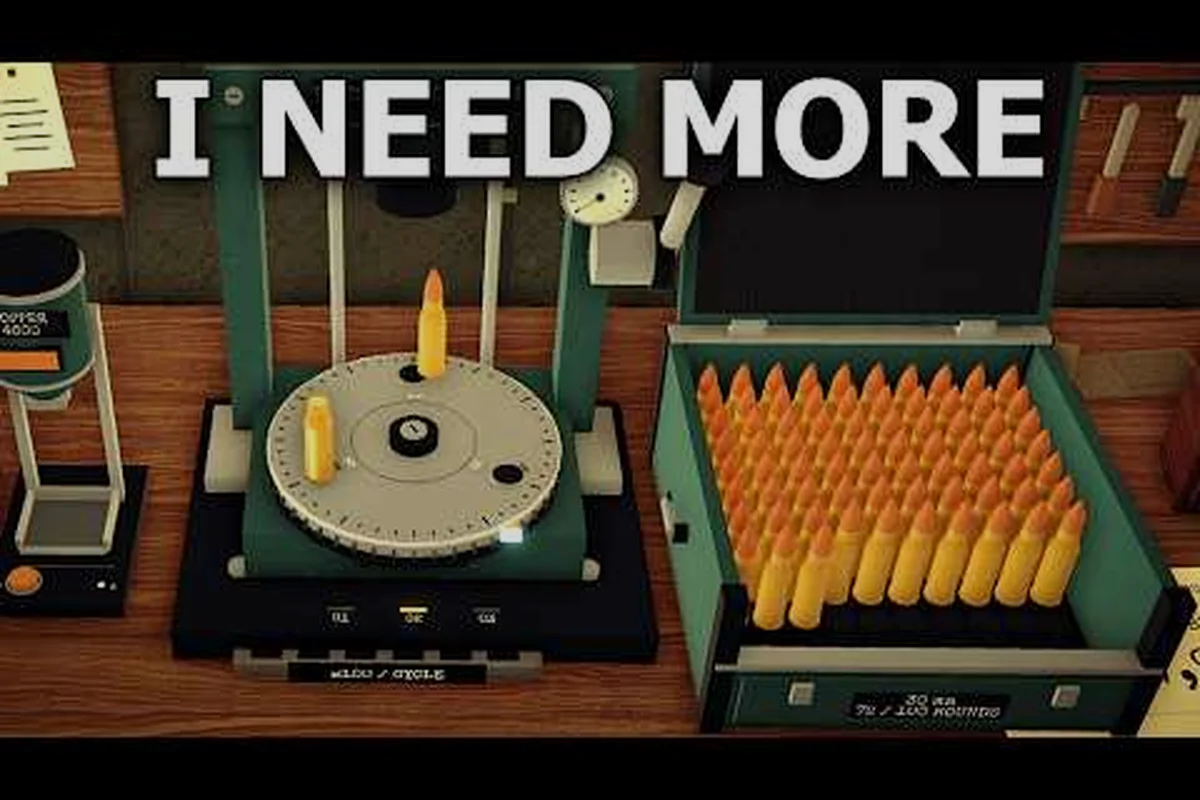
BRASS HELL factory gameplay turns ammunition production into a hands-on production puzzle centered on keeping the full production chain synchronized. Brass casings must arrive before the stamping press can form cartridges, while empty shells and finished rounds compete for limited storage and handling capacity. Operating the press also consumes resources, so each contract creates a trade-off between completing the order on time and preserving money for a larger workshop. Reinvesting earnings in faster presses, improved material flow, or additional packing capacity can shorten the production cycle and reduce the pressure of filling every order with rushed, inefficient batches.
Manage Connected Stations Instead of One Machine
BRASS HELL factory gameplay centers on turning raw material into finished ammunition, but the challenge comes from managing several connected stations instead of watching one automated machine. The press creates the required output; packing, sorting, and delivery then determine whether that output becomes money. Understanding this relationship is the key to a productive workshop, and every cycle should contribute to the next upgrade.
The central loop is a compact production chain in which each station feeds the next: the press manufactures ammunition, packing converts loose rounds into order-ready goods, delivery earns revenue, and reinvestment expands workshop capacity. For example, producing a large batch of rounds is only useful if the correct quantity and configuration are packed before submission; otherwise, the press output cannot be monetized and materials are effectively wasted. Balancing material preparation, press operation, packing, delivery, and reinvestment therefore matters more than maximizing output at a single station.
-
Acquire or receive the required material.
-
Load the press and choose the ammunition recipe available in the workshop.
-
Operate the press while maintaining a productive rhythm.
-
Collect the manufactured rounds.
-
Pack the ammunition into the requested quantity and configuration.
-
Complete the order and receive payment.
-
Purchase faster equipment, improved processing, or workshop expansion.
| Factory stage | Player action | Main benefit | Common mistake |
|---|---|---|---|
| Material preparation | Gather the input for the selected recipe | Keeps production from stalling | Pressing without the correct material |
| Press operation | Load, run, and collect ammunition | Creates sellable output | Rushing and leaving output unattended |
| Packing | Count and arrange rounds by order | Converts output into completed goods | Mispacking the requested type or amount |
| Delivery | Submit the finished order | Earns money and progress | Delivering incomplete goods |
| Reinvestment | Buy workshop improvements | Raises future production capacity | Spending before the production loop is stable |
This structure makes BRASS HELL game explained in fairly practical terms: the player is not simply earning currency from idle income. Each station can interrupt the next, and a successful player keeps the full chain moving. The broader production loop overview explains how these workshop tasks fit into the game’s larger progression structure.
Why the Factory Loop Matters
The factory does not become easier simply because the player makes more ammunition. A larger volume magnifies every delay. If packing is slow, finished rounds remain scattered around the workshop. If the wrong order is accepted, valuable output may sit unused. If all earnings go toward a flashy upgrade while basic tools remain neglected, throughput can fail to improve.
A productive setup depends on three linked ideas: production continuity, order accuracy, and reinvestment priority. Production continuity means little idle time between the press and packing. Order accuracy ensures that completed ammunition matches the customer’s request. Reinvestment priority directs money toward the part of the chain that currently limits growth.
A Simple First Production Cycle
Start with one order that uses a familiar recipe and requires a manageable amount. Run the press, collect every finished round, and pack them carefully. Note where the process slows down, whether that occurs while loading, operating, collecting, or packing. The first cycle is also a useful diagnostic for the wider guide to workshop systems and press mechanics.
Instead of judging the workshop only by total ammunition produced, measure completed orders per unit of time. That number gives a clearer picture of whether the factory is functioning as a business rather than a collection of partially used machines.
BRASS HELL Ammunition Factory Guide for Steady Output
A useful BRASS HELL ammunition factory guide focuses on repeatable routines. The exact menus and equipment depend on available upgrades, but the operational principles remain consistent: prepare only what you need, keep the press supplied, verify the recipe, and package the result before moving to another task.
Managing the Press Efficiently
The press is the obvious center of the factory, but producing rounds does not guarantee profit if the surrounding stations remain idle. Treat each press run as preparation for the next action rather than as an isolated task. If loading takes noticeable time, prepare material before beginning the cycle. If collecting is manual, stay near the press until its output is secured.
| Press-management habit | Practical result | What to observe |
|---|---|---|
| Prepare inputs in advance | Reduces waiting between cycles | Time spent idle beside the press |
| Finish one recipe at a time | Lowers confusion and sorting time | Accidental mixed ammunition |
| Collect output promptly | Prevents finished goods from blocking access | Crowded work surfaces |
| Match pace to packing speed | Creates a steady production rhythm | Backlog between press and packing |
| Pause for larger orders | Avoids exhausting supplies mid-cycle | Material remaining during fulfillment |
The goal is not maximum animation speed. It is a predictable interval between production stages. When the press and packing station operate in harmony, the workshop feels controlled; when they do not, the same output rate creates clutter and missed opportunities.
Packing With Fewer Corrections
Packing is where production becomes fulfillment. Each order adds constraints that must all be satisfied, so the player should confirm the type, quantity, and any stated packing requirement before sealing the shipment. Incorrect work can consume materials, create rework, and delay payment.
A reliable packing routine follows a short sequence because each BRASS HELL shipment must reconcile the order card with the ammunition type, requested quantity, and any special packing condition before it reaches the packing station. For example, if an order calls for 20 rifle rounds but the current batch contains mixed cartridges, reserve the correct stack first and treat the remaining output as inventory rather than assuming it can satisfy the order. This prevents material loss, rework cycles, and delayed payment while keeping the factory’s production line focused on the next fulfillment task.
-
Read the complete order before opening the packing station.
-
Select the required ammunition rather than relying on visual memory.
-
Count the grouped output against the requested amount.
-
Pack the final batch last if earlier rounds may not match the order.
-
Submit the shipment only after checking every requirement.
Order-first packing is the central lesson. In BRASS HELL factory gameplay, checking the order card before touching the packing station prevents a mixed batch from becoming a rejected shipment. For example, if the order specifies 20 rifle rounds, the player should reserve that exact cartridge type and count before adding any surplus output; otherwise, the wrong ammunition can consume materials, trigger rework, and delay payment. Confirming type, quantity, and packing requirements first keeps fulfillment predictable as the factory handles several ammunition types.
Recognizing a Bottleneck
When progress slows, inspect the entire path rather than immediately buying another press component. A faster press can increase output while making the bottleneck worse if packing and delivery already lag. Likewise, accepting more orders can create financial gains but also produce unfinished shipments.
| Symptom | Likely bottleneck | Better response |
|---|---|---|
| Press sits ready with no material | Input supply | Secure materials before another cycle |
| Finished rounds accumulate | Collection or packing | Clear output and package in batches |
| Packing is always busy | Manual handling capacity | Upgrade packing speed or improve output balance |
| Money rises but orders remain incomplete | Order volume is too high | Accept fewer or simpler contracts |
| Upgrades rarely improve completion rate | Purchases target the wrong station | Redirect money toward the limiting step |
These observations turn BRASS HELL game review territory from a general impression into a practical assessment of whether the progression system supports steady, satisfying play. For example, if the press cycle stays fast while ammunition piles up beside packing, a higher press tier will not improve throughput; the corrective upgrade belongs to collection or packaging capacity. Likewise, revenue can climb while contract completion falls when accepted orders exceed material supply and packing throughput. Measuring each production stage against contract deadlines exposes whether cash, output, and delivery speed are improving together, making the factory progression system easier to judge than raw income alone.
Route Finished Goods Toward the Active Order
Orders are the reason the factory exists, while crates and workshop facilities determine how efficiently finished goods can be routed toward them. This part of BRASS HELL factory gameplay connects production decisions to business strategy. Choosing what to make is only half the decision; the other half is deciding which demand can be served reliably without leaving the rest of the workshop unfinished.
Reading Orders as Production Instructions
An order should be treated as a compact production specification. It tells the player what ammunition to create, how much to prepare, and what finished quantity must arrive. Before accepting it, compare the requirement with current material, press capacity, packing speed, and any other active job.
| Order consideration | Early-workshop approach | Later-workshop approach |
|---|---|---|
| Recipe complexity | Favor a familiar ammunition type | Add recipes as production becomes stable |
| Required quantity | Complete smaller orders first | Batch work when upgraded tools support it |
| Packing needs | Verify every shipment carefully | Use repeatable checks for routine orders |
| Order value | Favor clear rewards and fast fulfillment | Compare profit with time and material cost |
| Number of active orders | Keep one main order moving | Run parallel orders only after bottlenecks are removed |
Before accepting an order, cross-check the ammunition type, required quantity, available materials, press capacity, packing speed, and the number of active jobs. For example, if the order demands a large batch but the workshop only has enough material for a partial run, the press may continue producing while the player repairs the mistake, but the resulting order still cannot be fulfilled. A preflight check prevents wasted press cycles, reduces rework, and keeps each shipment aligned with the specification.
Using the Crate System
Crates provide a physical bridge between production and delivery. Understanding where goods are placed, how orders are completed, and what remains in storage helps prevent finished ammunition from becoming invisible clutter. The dedicated explanation of the crate system and delivery workflow provides additional context for checking those relationships.
A clean crate arrangement creates three practical advantages. It makes the next order easier to identify, reduces time spent searching for required ammunition, and shows whether the workshop is actually producing what customers request. If a crate repeatedly contains surplus rounds while active orders remain unfinished, the issue is probably prioritization rather than a lack of ammunition.
What to Upgrade First
The best early purchase is usually the one that removes the most repeated delay. Do not choose solely from the largest number attached to an upgrade. Compare the upgrade with actual workshop behavior, especially the amount of time lost to loading, collecting, packing, and delivery.
| Upgrade target | Best when it addresses | Expected workshop benefit |
|---|---|---|
| Material access | Inputs regularly run out | Fewer empty press cycles |
| Press operation | Machine handling dominates downtime | More productive time per shift |
| Collection speed | Finished output waits in the workshop | Faster movement into packing |
| Packing system | Orders are made but not completed | Better order throughput |
| Storage organization | Goods become hard to locate | Faster order selection |
| Production capacity | Stable steps are already efficient | Higher output without idle gaps |
Balanced upgrades are more valuable than isolated speed increases. A workshop with a faster press but slow packing will only produce a larger backlog. Upgrades should create a connected line, and new recipes should be added only after the existing line can finish what it begins.
BRASS HELL Gameplay Review: Strengths and Limitations
A BRASS HELL gameplay review should consider whether its production systems create meaningful decisions rather than merely filling the screen with objects to click. The central appeal is the tactile connection between material, machine work, packing, and fulfillment. The strongest factory experiences arise when each action produces a visible consequence and every upgrade changes the rhythm of the workshop.
What Works Well
The production chain provides an immediate goal. Players can understand the broad task without reading a long manual: create ammunition, package it, and deliver completed orders. That clarity makes the game approachable, while the increasing number of recipes and workshop demands creates room for more advanced planning.
The most satisfying moments come from flow state, when material preparation, press operation, and packing happen in quick succession. At that point, the factory does not feel like a checklist. It feels like one connected machine operated by the player.
| Strength | Player benefit | Why it matters |
|---|---|---|
| Clear production chain | Makes cause and effect easy to learn | Supports quick onboarding |
| Hands-on workshop actions | Creates a stronger sense of contribution | Orders feel earned |
| Visible order requirements | Encourages accuracy and planning | Reduces accidental rework |
| Layered production tools | Provides meaningful upgrades | Progress changes routine operations |
| Flexible order priorities | Rewards active decision-making | Prevents one fixed solution |
For players who enjoy efficiency analysis, BRASS HELL factory gameplay rewards tracking completed orders, material reserves, and upgrade effects instead of relying on speed alone. For example, a player can compare the output of a single ammunition press with a parallel setup, then check whether packaging supplies become the bottleneck before adding more production equipment. Upgrade effects also matter because improved press speed or storage capacity changes how long each shift’s materials remain sufficient, revealing small gains that are easy to miss when presses, packing, and delivery demands overlap.
Where the Experience Can Frustrate
Repetition is the natural risk of a factory-centered game. If the player must repeat the same presses without meaningful decisions, progression can feel mechanical. The same issue appears when an upgrade costs a great deal but produces an unclear benefit, or when order complexity grows faster than handling capacity.
A good session should alternate between preparation, action, and planning. The challenge should shift from “can I make this order?” to “which of these orders and upgrades best uses my current capacity?” This is why understanding solo gameplay and its pacing is important for judging whether the loop remains engaging between major workshop changes.
Is BRASS HELL Worth Playing?
BRASS HELL is BRASS HELL worth playing for players who enjoy visible production progress, hands-on material handling, and optimization through small workshop decisions. The appeal is strongest when the order system stays understandable and the player can see a direct relationship between an upgrade, smoother actions, and more completed shipments.
The experience is less suitable for someone who wants a complex narrative or an entirely hands-off idle system. Its central satisfaction comes from participation. If the repetitive portions are unappealing, that can limit long-term appeal even when the underlying systems are sound.
| Player preference | Likely fit |
|---|---|
| Enjoys active production management | Strong |
| Likes optimizing workshops and orders | Strong |
| Wants a concise, systems-first experience | Moderate to strong |
| Prefers a story-driven campaign | Lower, depending on individual priorities |
| Wants no hands-on interaction | Low |
| Enjoys gradual, visible progression | Strong |
In this sense, BRASS HELL what is the game about is best answered through its central fantasy: running a small but growing arms workshop where material, machinery, and human effort combine to fulfill demanding contracts. The ammunition factory gameplay revolves around moving stock, operating production equipment, and completing orders within the workshop’s available capacity. For example, choosing a more efficient machinery upgrade can reduce repetitive handling and free up time for contract fulfillment, while the player’s strong fit for active production management makes that hands-on loop central to the experience rather than incidental.
Practical Strategies for a More Efficient Workshop
Better BRASS HELL factory gameplay comes from reducing wasted actions and preserving attention. You do not need to click as fast as possible; you need to make each click part of a deliberate sequence. The strongest improvement usually comes from identifying which station interrupts the line most often and restructuring your routine around that station.
Split Work Into Production and Fulfillment
Divide the work into production and fulfillment. During production, prepare inputs, operate the press, and collect the output. During fulfillment, identify the order, verify the requirements, package the ammunition, and complete the delivery. Separating the stages helps prevent mistakes because packing no longer happens while the press is demanding attention.
| Routine stage | Actions | Attention goal |
|---|---|---|
| Preparation | Select recipe, gather material, confirm quantities | Enter each cycle correctly |
| Manufacture | Operate press, collect output | Prevent unfinished rounds from accumulating |
| Verification | Match ammunition type and amount to order | Catch errors before packing |
| Packing | Package the confirmed quantities | Complete the shipment cleanly |
| Delivery | Submit order and collect reward | Move on without delaying the next cycle |
This routine also reveals where upgrades matter. If the preparation stage is quick but verification is slow, invest in packing or order management. If production is fluid but orders arrive too quickly, accepting fewer contracts may produce better results than buying another machine.
Use Small Buffers
A small buffer of prepared material can smooth the press cycle, but excessive stockpiling ties up money and space. Likewise, keeping only one order in the final packing stage can make the fulfillment phase easier to read. Buffers should be short and purposeful.
Demand matching is another useful principle: do not produce a large amount of a recipe without a clear destination. A large inventory may look efficient, yet it does not contribute to revenue if the requested ammunition is elsewhere. Before making another batch, check active orders and the crates already prepared for delivery.
Improve Decision-Making With Simple Records
A short record can prevent repeated inefficiency. Track the number of completed orders per shift, the materials that expire or sit unused, and the point where unfinished goods begin to accumulate. These measurements are more useful than total presses because they reflect the entire factory.
| Metric | What it reveals | Action prompted by a poor result |
|---|---|---|
| Completed orders per shift | Overall factory throughput | Remove the most common delay |
| Rejected or corrected shipments | Packing accuracy | Recheck order details earlier |
| Idle press cycles | Material or attention bottleneck | Prepare inputs earlier |
| Packing backlog | Capacity mismatch | Upgrade packing or reduce output |
| Surplus recipe inventory | Poor demand matching | Produce closer to active orders |
In BRASS HELL, the clearest early upgrade decisions come from tracking how each machine change affects the whole production chain, not merely whether a press runs faster. For example, if completed orders per shift rise while packing backlog also grows, a new production press has increased throughput without solving the real bottleneck; upgrading packing capacity or adjusting order timing would produce a better payoff. This simple comparison makes costly expansions easier to justify and prevents ammunition recipes, inputs, and finished goods from accumulating faster than they can be processed.
Learn the Game Before Optimizing Everything
A broader new-player overview of BRASS HELL can help with basic navigation and progression pacing. For factory play specifically, resist the urge to unlock every station immediately. Learn the loading rhythm, packing sequence, and order requirements before making the workshop more complicated.
That approach also prepares the player for the deeper mechanics overview in what kind of game BRASS HELL is. Factory systems become more meaningful when the player understands how active work, upgrades, and orders support one another.
BRASS HELL Factory Gameplay: Final Production Priorities
The strongest BRASS HELL factory gameplay comes from a workshop that finishes what it starts. Prepare the right material, operate the press with a stable rhythm, collect the output, verify the order, and pack the shipment without unnecessary corrections. Then reinvest in the station that limits the whole chain.
Progress should be measured by completed orders, not ammunition sitting unfinished. Upgrades matter when they remove a recurring bottleneck, and new recipes are valuable only when the workshop can package and deliver them reliably. For players evaluating the broader experience, this production-focused assessment complements a general BRASS HELL game review by showing how the core loop feels in practice.
Frequently Asked Questions
What is BRASS HELL factory gameplay focused on?
BRASS HELL factory gameplay focuses on producing ammunition, packing it according to customer requirements, and completing orders. The workshop forms a connected production chain, so every station matters. A fast press cannot compensate for slow packing, and a large stockpile has little value when completed shipments remain the actual goal.
How do I improve ammunition production in the workshop?
Improve production by measuring where work stops, then upgrade the station responsible for that delay. Prepare inputs early, collect finished rounds promptly, and keep packing aligned with the order queue. Buy speed only when it solves a measured bottleneck, because a faster press without matching packing capacity creates a larger backlog.
Is BRASS HELL worth playing for factory simulation fans?
BRASS HELL is worth playing for factory simulation fans who enjoy active production and incremental workshop improvement. Its appeal comes from visible material handling, connected machines, and meaningful order decisions. Players who prefer complex stories or completely automated idle production may find the core loop less engaging.
What should a new player learn first in BRASS HELL?
New players should first learn the sequence of material preparation, press operation, collection, packing, and delivery. Accuracy matters because an incorrect ammunition type or quantity can require rework. Once that basic chain is reliable, players can study upgrade values and begin balancing multiple orders without allowing too many active contracts.
Does BRASS HELL have a deep gameplay review beyond the press?
BRASS HELL has gameplay depth beyond the press because the workshop includes packing, delivery, storage, order selection, and upgrades. The most interesting decisions occur when several systems compete for limited time. A useful review should examine completed-order speed, correction frequency, inventory flow, and whether each purchase makes the entire factory function more smoothly.