
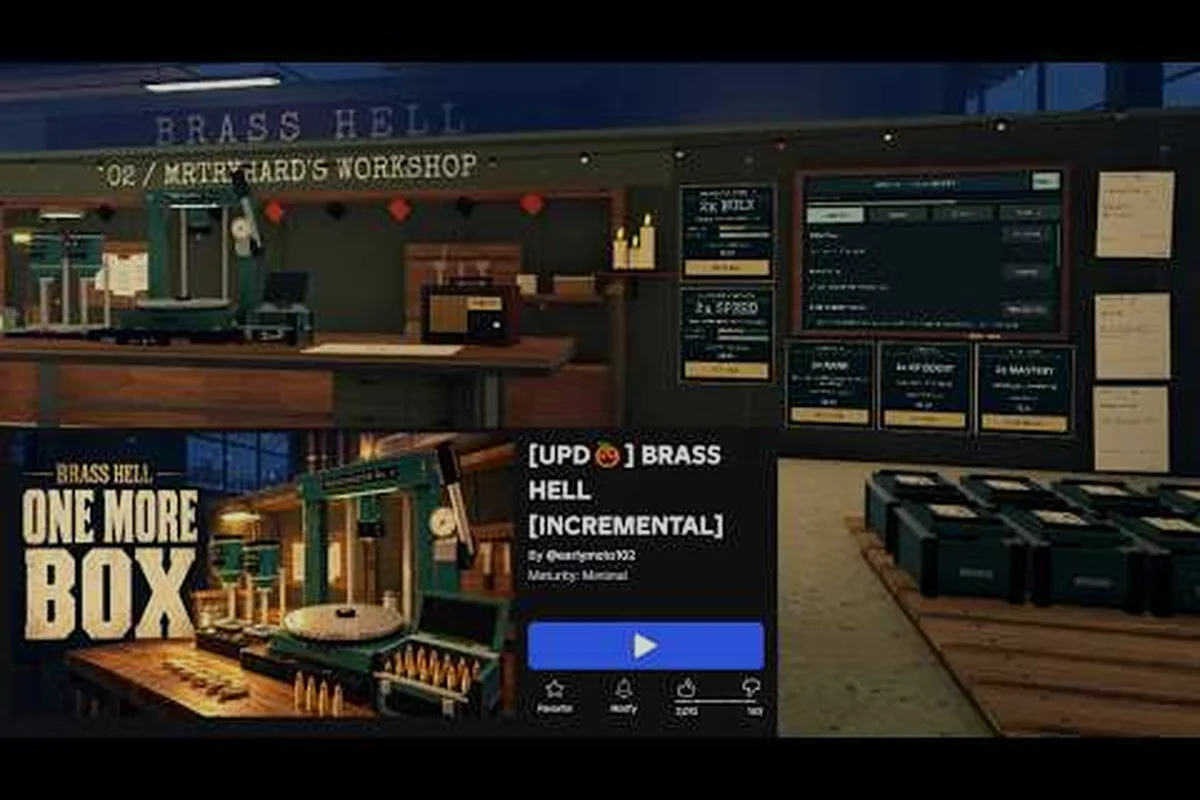
BRASS HELL how it plays centers on a compact production loop: transform materials, fill orders, earn money, and reinvest in workshop improvements. The attraction comes from watching a manual craft become a steady operation, although the early game still rewards attentive hands-on work.
BRASS HELL How It Plays at a Glance
The central activity is not simply making items; it is turning those items into completed orders before moving to the next production stage. A basic run starts with available materials, sends them through a production action, checks the requested crate, and converts a successful delivery into money for future improvements.
That cycle gives BRASS HELL how it plays a clear rhythm: prepare materials, run the production action, verify the crate, deliver the order, and reinvest the income in workshop upgrades. For example, an upgrade that increases production capacity or reduces preparation time shortens the BRASS HELL production loop, so fewer actions are needed to fill each requested crate. The result is less idle-game downtime and a smoother incremental-game progression, because workshop improvements directly support the factory-sim loop instead of leaving players repeatedly handling the same manual steps.
| Core activity | What you do | Immediate benefit |
|---|---|---|
| Gather materials | Select the inputs needed for the current order | Starts a usable production cycle |
| Produce goods | Run the available crafting or workshop action | Creates items for a requested crate |
| Fill the crate | Match the order’s required quantity | Prepares the shipment |
| Deliver the order | Submit the completed crate | Earns money |
| Upgrade the workshop | Purchase a production or capacity improvement | Reduces friction in later cycles |
Your First Order as a Small Checklist
Your first cycle is easiest to understand as a small checklist rather than a complex factory plan. Look at the requested order, identify the required material, use the available production control, place the finished goods into the crate, and deliver it.
Do not skip the crate step. Producing the correct item does not necessarily complete the order if the shipment still needs the requested quantity. This distinction is central to understanding BRASS HELL production loop systems: the workshop creates goods, while the crate and delivery stages convert those goods into payment.
What changes as you progress
Early production is mostly direct. You select what is needed, make the goods, fill the crate, and submit the order. As the workshop grows, available actions expand, and the pressure shifts from learning the interface to maintaining several related steps without wasting materials.
The transition from active crafting to broader production is gradual rather than a sudden genre switch. You still perform useful actions, but upgrades make those actions more productive. That makes the early manual experience meaningful while preparing the foundation for the later factory sim guide approach.
BRASS HELL Production Loop and Resource Flow
The BRASS HELL production loop turns workshop inputs into materials, crafts those materials into goods, and packs the required quantity into a crate for delivery. Because each stage depends on the previous one, a slowdown at material selection or crafting can prevent the entire order from being completed. For example, producing ten brass units but only nine in the crate will not trigger the delivery payout. Upgrades then affect this chain by increasing production speed, expanding the available material pool, or reducing the time needed to fulfill each order.
The key is to watch what a successful cycle actually consumes. If every completed order takes the same route, your priority should be improving that route first. Spending money on an unrelated upgrade may look productive, but it can leave the actual bottleneck untouched.
| Production stage | Input | Output | Common mistake |
|---|---|---|---|
| Material selection | Available workshop inputs | Correct production material | Selecting too many inputs |
| Crafting | Required material | Finished goods | Producing more than the order needs |
| Crate filling | Finished goods | Requested crate quantity | Leaving the crate incomplete |
| Delivery | Completed crate | Money and progression | Delivering before verifying requirements |
| Workshop growth | Money from deliveries | Faster or broader production | Upgrading away from the active bottleneck |
Follow one order from start to finish
Choose a single order and trace every stage before speeding up. Count how many materials you select, how long the production action takes, whether extra goods are generated, and how many items the crate requires. These observations create a reliable baseline for comparison.
If the order requires one crate and your current output exceeds that amount, redirect the excess toward another order when possible. If the crate remains empty because production produced an unrelated item, correct the input instead of repeating the same action. Errors tend to compound quickly in an incremental game because each wasted material reduces the money available for the next cycle.
Treat materials as linked dependencies
Material demand is the practical bridge between individual orders. If one order consumes the same input required by a later order, producing the earlier order may prepare the workshop for the next one. If it uses unrelated inputs, switching between them can interrupt the rhythm of your session.
Community experience suggests that the best early production plans follow repeatable material routes rather than jumping whenever a new order appears. That observation is especially useful in a BRASS HELL simulation game guide because it turns a dense interface into a short checklist: confirm the input, complete the required quantity, package the result, and deliver it.
Orders, Crates, and Workshop Management
Orders are the source of direction in BRASS HELL: they define what must be produced, the quantity required, and the destination for the finished goods. Reading each order carefully prevents wasted brass and workshop time. For example, if a request calls for a specific part in a set quantity, the production queue should match that amount rather than the fastest visible button, which may create an unwanted surplus or leave the order incomplete.
A crate functions as a shipment-specific checklist: confirm the requested brass goods, required quantity, and destination before sealing it. For example, an order for five fittings headed to a specific warehouse should produce a crate containing exactly five fittings, not the largest stack available or a mixed batch from another production request. During delivery, compare the crate against the active order and shipment label; a mismatch can leave a valid production order incomplete while tying up inventory intended for a different destination. This final check is especially valuable when several orders sit in the production queue, since it catches quantity and routing errors before the delivery cycle resolves them.
Inspect the Request Before Starting the Press
Start with the requested item, then confirm the quantity, the crate type, and any destination information shown on the interface. If the production screen offers several recipes, select the one that matches both the requested good and the quantity currently required.
This order-first approach prevents the common mistake of producing an item simply because its materials are already selected. It also creates a useful rule for sessions with limited attention: the order is the source of truth, and the workshop is the tool for satisfying it.
Match crate contents to demand
When a crate requests fewer goods than you produced, keep the surplus available for another job rather than placing everything inside. When a crate remains short, return to production only if you still have the necessary materials. Repeatedly pressing an unavailable or irrelevant option does not advance the delivery.
| Order status | Best response | Why it works |
|---|---|---|
| Missing input | Gather the required material first | Prevents wasted production attempts |
| Goods ready, crate empty | Place the requested quantity | Completes the packaging stage |
| Crate full, undelivered | Verify requirements and deliver | Converts inventory into payment |
| Surplus goods produced | Reserve them for another order | Reduces material waste |
| Repeated failed attempt | Re-read the order and recipe | Identifies a mismatched selection |
Delivery is part of production
A common misunderstanding is treating delivery as a separate administrative action. In practice, delivery closes the production cycle and confirms that you satisfied the request. It also creates the currency needed for your next upgrade, so an undelivered crate is unfinished work even when the goods are visible in storage.
For more detail on the surrounding systems, examine how the orders and delivery mechanics work. The important habit is to confirm that the requested quantity is in the correct crate before pressing the final control, because producing and packaging remain incomplete until the shipment is accepted.
BRASS HELL Idle Game Mechanics and Active Play
BRASS HELL idle game mechanics describe how progress continues through repeatable systems, but the game does not remove the value of active decisions. Your attention determines whether materials are selected correctly, whether surplus is managed, and whether the next order fits your current workshop setup.
The idle element is best understood as a reward for preparation because BRASS HELL’s production loop continues only as far as your workshop resources allow. Upgrades strengthen your infrastructure, while active play lets you redirect production, clear backlog, and complete orders that unlock new possibilities. For example, pairing machines through adjacency bonuses keeps the production chain efficient when you are offline, but fulfilling a nearby order can provide the cash needed to add a new machine or improve an existing link rather than allowing resources to accumulate without further use.
What active play actually means
Active play involves monitoring state rather than holding one button indefinitely. You check the current request, move resources into position, run the relevant action, and verify the result. When the system is working well, each action becomes quicker because earlier investment has removed repetitive friction.
That balance creates a satisfying progression curve. New players make visible mistakes while learning the interface, then experienced players spend more time optimizing sequences and choosing upgrades. The hands-on phase never disappears entirely; instead, its purpose changes from learning every control to preventing avoidable losses.
Why upgrades matter
Workshop upgrades improve the economics of repeated cycles. Depending on the upgrade, they may increase capacity, improve output, reduce wasted materials, or open additional production options. The exact effect should always be read from the in-game description, because upgrade behavior can change as the game develops.
Use the current delivery income to judge whether an upgrade supports your most common order. A production improvement that reduces the cost of your repeated route usually has more value than a visually exciting feature that rarely matches current demand. This is the practical principle behind an effective BRASS HELL factory sim guide: upgrade the constraint that limits your current cycle.
| Play style | Main action | Best upgrade criterion | Common risk |
|---|---|---|---|
| Beginner | Follow one order at a time | Simplifies inputs and packaging | Spending before the first full cycle |
| Steady player | Alternate compatible orders | Improves repeated material flow | Creating surplus in the wrong item |
| Optimizer | Plan output around several crates | Raises capacity or reduces waste | Overcomplicating early routing |
Active and passive progress work together
A small, consistent session can create useful momentum because every completed order contributes to workshop growth. Larger sessions become more valuable when they let you spot inefficiencies, such as repeatedly selecting materials that do not match the next request or delivering partially prepared crates.
Reported by players, the most effective sessions combine short production bursts with regular upgrades. The exact timing varies by order availability and progression state, but the principle remains stable: finish a complete cycle, collect the result, then decide which bottleneck deserves the next purchase.
A Practical BRASS HELL Simulation Game Guide for Progression
Progress becomes smoother when every purchase has a clear purpose in the BRASS HELL production loop. Record the current order, materials used, production time, and money earned before changing a machine or recipe. After each upgrade, compare total cycle time and profit per order, not just price or appearance. For example, if a faster machine cuts production time but raises operating costs, calculate the break-even output before committing; this reveals whether the upgrade improves your idle progression or merely shifts money from purchasing to upkeep.
Build a repeatable opening routine
A reliable opening routine keeps the first minutes of every session efficient. Begin by checking the requested crate, confirm the required quantity, select the matching material, produce the goods, fill the crate, and deliver it. Add a short review afterward to identify anything that blocked completion.
This routine also reveals which system needs attention. Repeated input errors point toward slower material handling; recurring quantity mistakes point toward crate management; consistently low returns point toward inefficient production choices. The categories are practical because each leads to a different adjustment.
Upgrade in three passes
Use three passes to prevent spending mistakes in BRASS HELL. The repair pass fixes a failed or blocked cycle—for example, adding a missing input crate before checking why a production line has stopped. The efficiency pass then targets the cycle your factory repeats most often, such as speeding up a high-frequency recipe without overinvesting in rarely used machinery. Finally, the expansion pass adds capacity for a new order type or reduces recurring waste, helping your production loop support fresh demand instead of merely repeating the same bottleneck.
| Upgrade pass | Question to answer | Example target |
|---|---|---|
| Repair pass | What currently blocks delivery? | Correct input or complete crate |
| Efficiency pass | What action repeats most often? | Faster or cheaper production |
| Expansion pass | What new demand should be supported? | Additional capacity or recipe access |
Because prices and available upgrades are part of the live game state, verify their current values before purchasing. The table provides a decision framework rather than fixed costs or universal upgrade rankings. That distinction keeps the guide accurate as progression changes.
Learn the crate and workshop relationship
The crate system is easy to overlook because it sits between production and delivery. For a fuller explanation of its role, read the workshop crate and press overview. The core takeaway is that an item in storage is not the same as a satisfied order: quantity and placement still need to match.
A useful final check before delivery asks three questions: Is the requested item correct? Does the crate contain the required quantity? Is the destination selected correctly? If all three answers are yes, delivery should be the next action rather than another production attempt.
Common Mistakes in BRASS HELL Incremental Game Play
Most early failures come from rushing, not from lack of optimization. The interface contains several related controls, and pressing the wrong one may create clutter without progressing the order. Slowing down for one verification step is usually faster than repairing the resulting resource loss.
Producing without reading the request
A fast player can accidentally make the wrong item because several recipes use similar controls. Read the order label immediately before selecting materials, and confirm the recipe name afterward. This habit is especially valuable after unlocking additional goods, when the number of plausible choices increases.
Ignoring surplus output
Surplus is not always waste, but it becomes a problem when stored goods no longer match active orders. Keep a mental or written list of completed quantities, then assign surplus to a confirmed future request. Avoid creating extra stock simply because one action can produce more than the current crate needs.
Spending without a bottleneck
New upgrades feel rewarding, yet buying them out of order can leave the core loop unchanged. Before purchasing, name the exact problem the upgrade addresses. If the answer is vague, save the money and gather another delivery cycle to make the bottleneck clearer.
Delivering incomplete crates
A partly filled crate may look ready because its visual frame is present. Compare the contents with the order requirement instead of relying on appearance. This simple check prevents wasted time and supports the central idea behind BRASS HELL incremental game explained sessions: every stage must be completed in order.
BRASS HELL How It Plays During Your First Session
A first session should produce a small number of complete deliveries rather than many unfinished actions. For example, finish one order from acceptance through production and sale before queueing another, then check the resulting income, production time, and available upgrade. This keeps the BRASS HELL production loop stable, reveals how an upgrade affects output, and prevents a growing pile of half-processed jobs from obscuring which change actually improved your factory.
Start with one order and finish it before accepting another. After delivery, note the money earned and identify the next upgrade that directly improves that route. Continue with a second order, then compare whether the upgrade reduced clicks, improved output, or simply expanded your options.
A concrete first-session checklist
Use the checklist below as a practical tutorial for your first ten orders, treating each completed crate as a small BRASS HELL production-loop test. Track materials consumed, goods crafted, and income earned so you can compare the starting workshop with the upgraded one. For example, if the first order needs ten units but your production rate only supplies six per cycle, you can identify the bottleneck before buying another upgrade.
- Read the requested product and required quantity.
- Confirm the crate destination before crafting.
- Select only the materials required for that product.
- Produce enough goods to fill the crate.
- Verify the crate contents against the order.
- Deliver the completed order.
- Record the income and first upgrade choice.
- Repeat with a second order using the upgraded workshop.
This sequence is deliberately straightforward because it teaches feedback before optimization. The first orders reveal production costs and the crate requirement; later orders test whether the upgrade helped. By keeping records from the beginning, you gain a progression baseline instead of relying on vague impressions.
When to expand the routine
Move toward multiple orders when you can finish one cycle without hesitation and the workshop has enough capacity for another request. Do not expand merely because a faster control is visible. The right measure is reliable completion, since incomplete orders create both a backlog and a misleading impression of your production speed.
Once you begin experimenting, the deeper factory gameplay overview can help you evaluate whether your workshop resembles a connected operation. Even so, keep one order fully visible until the system becomes predictable, because tracking several requests at once is useful only after each individual action is understood.
Frequently Asked Questions
Is BRASS HELL mostly idle?
BRASS HELL mixes incremental workshop growth with active production decisions. Upgrades improve input handling, output speed, or capacity, but they do not automate the core loop: you still choose each recipe, gather the matching inputs, convert surplus materials, fill the requested crate, and decide which order to fulfill next. For example, holding extra brass for a confirmed order can prevent repeated production runs, while completing a simpler order first may fund a more valuable upgrade.
What is the basic production cycle in BRASS HELL?
The basic cycle is to read an order, gather the matching material, produce the required goods, fill the requested crate, and deliver it. Payment from that delivery becomes the foundation for workshop upgrades, allowing later cycles to become faster or more scalable.
Should I upgrade immediately or keep crafting?
Keep crafting until you have completed enough orders to identify a real bottleneck. Then buy the upgrade that addresses that bottleneck, such as easier input handling, better output, or additional capacity. Upgrading without a clear purpose can leave the same bottleneck in place.
How do I avoid wasting materials in the production loop?
Read each order before selecting materials, then produce only the quantity the current crate requires; surplus brass or other inputs should remain reserved for another confirmed request. If a production action repeatedly fails, recheck the recipe, input type, and output rather than repeating the same selection. For example, when an order needs two brass goods, crafting a third can create inventory that delays a later recipe, while correcting the input mismatch prevents wasted materials and keeps the workshop’s production loop efficient.
Does BRASS HELL become a factory simulation?
Yes, but only gradually: BRASS HELL retains its hands-on crafting loop while adding factory-style routing, request fulfillment, and material management as workshop upgrades expand capacity. Early production is largely direct, with each brass good made for a specific order; later, batching, surplus inventory, and output bottlenecks require more planning. The change is operational rather than fully automated, because choosing recipes, matching inputs, and delivering orders remain the player’s responsibility.