
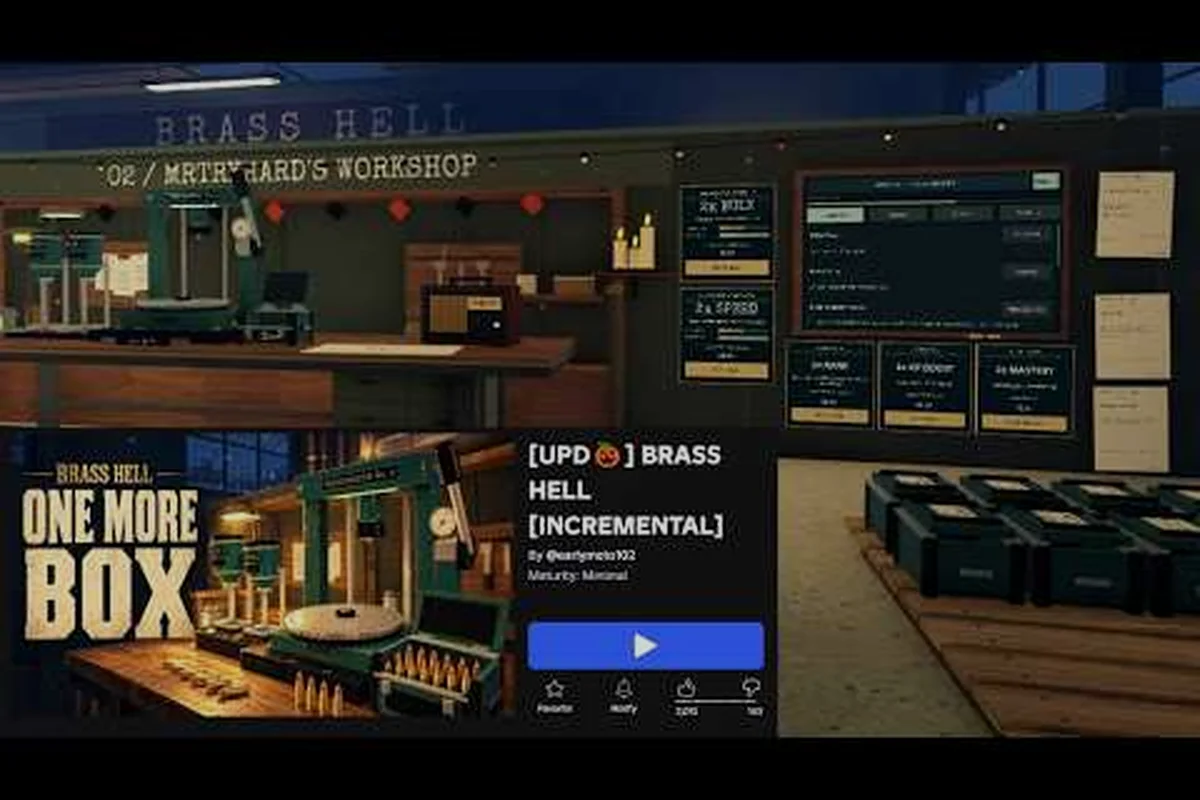
BRASS HELL solo progression depends on keeping production, packing, and deliveries moving without waste. A practical BRASS HELL progression order prioritizes Brass Jobs that provide quick cash and useful materials, then uses that income to improve workshop speed, packing efficiency, and delivery capacity before tackling slower, more resource-intensive jobs. For example, alternating inexpensive brass jobs with higher-value contracts can prevent long production queues, while delivering on time preserves the reputation needed for better-paying work. This order directly improves BRASS HELL progression speed by reducing idle time and costly mistakes.
BRASS HELL Solo Progression Starts With Factory Flow
Strong BRASS HELL solo progression begins by reducing idle motion and idle production. The key is not simply making more items; it is keeping the press, packing area, and delivery side synchronized so each finished product reaches the next stage quickly.
Production Flow is the central measure: raw materials enter, crafted goods are packed, and finished crates leave the workshop. If any link stalls, you lose time while the other parts of the factory sit idle. Track the slowest link rather than assuming the busiest machine is the most valuable one to upgrade.
| Production stage | Common solo bottleneck | Best response |
|---|---|---|
| Material preparation | Repeated trips for small inputs | Keep a visible staging area near the workbench |
| Press operation | Waiting for individual batches | Plan craft sequences around compatible recipes |
| Crate packing | Items scattered across the floor | Standardize one packing layout |
| Delivery preparation | Late notice of incomplete orders | Check requirements before starting the next batch |
| Workshop improvement | Upgrading a fast station too early | Improve the current bottleneck first |
The fastest progression tips begin with observation. Community reports often describe solo success as Line Discipline: completing one short production cycle before beginning another overlapping task. This does not mean working on only one recipe forever; it means creating a repeatable sequence that limits wasted steps.
Build a Repeatable Shift
Write down your current loop as a simple chain: gather inputs, press goods, pack them, collect payment, and return to the most profitable recipe. Once the loop is stable, make small improvements. A recipe that produces more units per minute may be worse than a simpler recipe that keeps every station occupied.
Use the BRASS HELL beginner guide to establish the basic controls and workshop layout, then focus on the shortest profitable loop. The useful comparison is not raw output; it is completed crates per shift after travel, packing, and delivery time are included.
| Loop option | Output per craft | Preparation effort | Packing burden | Solo suitability |
|---|---|---|---|---|
| Simple repeated recipe | Low | Low | Low | Strong early choice |
| Mixed product cycle | Medium | Medium | Medium | Useful for varied orders |
| Long high-value sequence | High | High | High | Better after upgrades |
| Complex multi-stage recipe | Variable | Very high | High | Risky as a startup activity |
Focus on two metrics during each run: time to first completed crate and number of unfinished orders at shift end. A fast start with poor packing can still produce slow BRASS HELL progression speed because finished goods remain trapped inside the workshop.
BRASS HELL Progression Order for a Solo Workshop
A stable BRASS HELL progression order begins with fundamentals that reduce travel, then adds recipes, then improves throughput. Resist the temptation to chase the most expensive product immediately because high-value goods usually demand better timing and more careful material handling.
Phase 1: Remove Movement Waste
Position crates, packaging materials, and delivery-ready goods so each craft follows the shortest practical route. Keep frequently used supplies within easy reach, while finished products move in the opposite direction from incoming materials. This separation prevents workers—especially a solo player—from crossing the same floor repeatedly.
| Early objective | Success condition | Why it matters |
|---|---|---|
| Clean production line | No abandoned goods remain on the floor | Prevents forgotten inventory |
| Dedicated packing spot | Every crate uses the same sequence | Reduces search and placement time |
| Material staging area | Inputs are grouped before crafting | Prevents extra trips |
| Delivery buffer | Finished crates wait in one marked zone | Clarifies what is ready to ship |
The four-stage loop is the best starting structure: prepare, press, pack, and deliver. Each stage should end where the next begins. Small improvements matter because a two-second saving repeated across dozens of actions becomes a meaningful increase in BRASS HELL progression speed.
Phase 2: Add Profitable Recipes
Once the basic production loop runs smoothly, add a second recipe that shares inputs or fulfills a nearby order, such as pairing an intermediate component with a closely related final product. Reusing preparation work reduces redundant handling, while matching a demand node lowers the risk of producing crates without an immediate destination. For solo progression, compare the Similar input recipe and High-demand recipe options in the table below: the former usually requires only slight handling adjustments, whereas the latter increases order value at the cost of extra packing time.
| Recipe choice | Benefit | Cost | Best timing |
|---|---|---|---|
| Existing recipe only | Simple and predictable | Limited income | First production stage |
| Similar input recipe | Reuses preparation work | Slightly more complex handling | Early expansion |
| High-demand recipe | Larger order value | More packing time | Mid progression |
| Multi-stage recipe | Strong late-game potential | Heavy dependency on supplies | Mature factory |
For exact recipe relationships and machine requirements, consult the BRASS HELL crafting recipes list. Use it as a reference for your progression order rather than crafting every listed item at once. Select recipes that fit the current bottleneck and increase total completed orders, not merely the value of one crate.
Phase 3: Upgrade the Constraint
An upgrade helps when it removes the most frequent interruption. If materials are always the problem, improve gathering or preparation. If packing is slow, upgrade the packaging side. If the press creates finished goods faster than you can clear them, increasing press output can actually make the factory less efficient.
| Observed constraint | Upgrade target | Expected result |
|---|---|---|
| Frequent material trips | Storage or preparation capacity | Fewer return journeys |
| Long press waits | Process speed or recipe flexibility | Better batch utilization |
| Slow crate assembly | Packing tools or station layout | Faster order completion |
| Limited delivery capacity | Vehicle or delivery access | More revenue per trip |
This decision framework keeps BRASS HELL fast progression tips grounded in measurable behavior. Record which action causes the longest delay, upgrade that area, and compare the next ten orders against the previous ten. Community testing is useful for discovering recipes, but the factory’s recorded delay is the best local evidence.
BRASS HELL Fast Progression Tips for Limited Playtime
Short sessions reward preparation because setup work must not consume the entire play window. The best BRASS HELL fast progression tips are designed around a clear start and finish: open with a complete production cycle, stop before unfinished work becomes a tangled chain, and preserve an obvious restart point.
Use a Session Block
Divide each session into preparation, production, and cleanup. For example, spend the opening moments arranging materials, the middle portion completing several orders, and the final moments packing or staging one last item. This structure converts BRASS HELL how to grind efficiently advice into a practical schedule.
| Session length | Recommended target | Why |
|---|---|---|
| 10–15 minutes | One clean production cycle | Avoids unfinished setup |
| 20–30 minutes | Several compatible orders | Rewards preparation |
| 45+ minutes | Production plus one upgrade | Allows deeper improvement |
A useful stop rule is to finish only activities that can be completed before time expires. If a recipe requires several long presses and complex packing, start it only when enough session time remains. Leaving half-finished goods creates cleanup work and reduces the value of the next session.
Use Buffers Instead of Panic Crafting
Reserve valuable materials for the recipes that contribute most to your next unlock. Crafting indiscriminately fills the floor with low-value products, creates visual clutter, and makes it harder to identify which goods support upcoming milestones. This is especially important in a BRASS HELL grinding guide because repeated low-value work should still lead toward a larger goal.
Keep a short queue with three entries, and reassess it after each completed workshop production cycle rather than letting it become a rigid shopping list. For example, if the Now recipe can use materials already reserved for the Next upgrade, complete it first and avoid collecting inputs twice. Only promote an item to Later when its ingredient chain is clearly behind both active recipes, which preserves momentum toward the next workshop upgrade without sacrificing progression speed.
-
Now: the recipe best suited to prepared materials and nearby orders.
-
Next: the highest-value recipe whose inputs are nearly available.
-
Later: the upgrade or milestone that should guide the next production block.
That queue prevents the common solo failure of reacting only to the newest visible order. It also makes BRASS HELL solo progression more deliberate: each craft has a role, each trip has a destination, and every session contributes to the next workshop upgrade.
Keep One Ready-Made Batch
If materials and recipes permit, leave a small batch of common inputs prepared for the next session. This reduces startup friction and provides an immediate useful action when time is short. The batch should be modest because excess materials tie up space and may become less useful after recipes or orders change.
The solo progression checkpoint guide can help organize these milestones and restart points. Apply its checkpoints to your own schedule: identify the next meaningful upgrade, prepare the required materials, and end each session with that target clearly visible.
BRASS HELL Grinding Guide for Efficient Crate Production
Efficient grinding is a production problem, not a repetitive clicking problem. The purpose of a BRASS HELL grinding guide is to show where time disappears and which changes reduce those losses. Start by separating active time from waiting time, then improve whichever stage creates more unfinished crates.
Measure One Complete Order
Use a sample of five completed orders and record preparation, crafting, packing, and delivery time separately. Calculate the average for each stage, but also track the slowest order and the stage where its delay occurred; a 12-minute crafting average can hide a one-off stall caused by an incompatible recipe or missing material. For solo BRASS HELL progression, this stage-level timing reveals whether progression speed is limited by press output, crate layout, or late delivery checks, giving you a measurable target for the next five orders.
| Stage | Questions to answer | Correction |
|---|---|---|
| Preparation | Are materials gathered in one trip? | Group inputs by recipe |
| Crafting | Does the press idle between jobs? | Pre-stage compatible materials |
| Packing | Are components missing or misplaced? | Use a consistent crate layout |
| Delivery | Is the order ready before loading begins? | Verify requirements early |
This breakdown makes BRASS HELL how to grind efficiently less dependent on guesswork. If crafting consumes most of the shift, focus on output and recipe value. If packing takes longer, simplify packaging rather than buying more production capacity. A fast press feeding a crowded packing table creates a bottleneck that no amount of patient crafting will fix.
Prioritize Total Value per Minute
Compare recipes using the value of completed and sellable goods divided by the full cycle time. Include the cost of materials, movement, and wasted attempts. A lower-priced recipe can be stronger if it completes twice as often and leaves the workshop free for another order afterward.
| Metric | Better candidate | Weaker candidate |
|---|---|---|
| Value per craft | Higher | Lower |
| Value per minute | Higher after all labor | Lower |
| Order fit | Matches current demand | Unnecessary output |
| Material overlap | Reuses staged inputs | Requires new preparation |
| Crate completion | Reliable | Often delayed |
Community data is most useful for identifying recurring recipes, while your own timing log remains authoritative for this particular factory layout. Checkpoints and unlock priorities are covered in the broader BRASS HELL progression guide, which can help connect each grinding session to a concrete milestone.
BRASS HELL How to Grind Efficiently Without Spreading Resources
Overextension is a common reason solo progression stalls. The workshop may contain excellent recipes but lack the materials, time, or space to complete them. A tight BRASS HELL how to grind efficiently plan limits simultaneous projects so the factory can finish what it starts.
Control the Number of Active Recipes
Use three recipe states: active, staged, and parked. Only the active recipe receives production time. Staged recipes have their inputs prepared but wait for a clear transition point. Parked recipes remain possible future options without consuming space, attention, or valuable inputs.
| Recipe state | Definition | Allowed action |
|---|---|---|
| Active | Producing during the current block | Craft and pack normally |
| Staged | Inputs are prepared | Finish before starting another |
| Parked | Valuable but not currently efficient | Reserve materials |
This control limits half-finished inventory, a hidden tax on a solo factory. It also creates a natural BRASS HELL progression order: complete active work, prepare staged work, then move only when the current order or crate is finished. Better milestones can be managed through the best progression path guide.
Reserve Materials for Upgrades
Some upgrade paths require materials that are easy to consume during routine grinding. Reserve the required amount immediately after identifying the next goal, even if the ordinary production recipe still uses the same resource. Spending every available unit can leave you one full cycle short of an important unlock.
A practical reserve has three parts, each calculated from the next production cycle rather than from a vague stockpile total. Set aside enough raw materials for the planned product mix, earmark the exact components for the next workshop upgrade, and keep a small emergency buffer for substitutions. For example, if the next run needs 20 copper and 8 brass components, reserve those figures before spending the remaining inventory on lower-priority orders; this prevents routine grinding from delaying a profitable recipe or forcing a costly material substitution.
-
Recipe reserve: materials needed for the next several orders.
-
Upgrade reserve: materials assigned to the next meaningful workshop improvement.
-
Flex reserve: a small buffer for replacement jobs or delayed orders.
Do not treat the flex reserve as spare income: its role is to absorb a failed or interrupted production cycle, not to fund extra orders. If a replacement job misses a deadline, the flex reserve can cover the material gap without consuming the stock assigned to the next workshop upgrade. For example, keep the emergency buffer intact even when an upgrade is only one profitable run away; otherwise one mishap can force a slower recipe, reduce BRASS HELL progression speed, and break the planned sequence of unlocks.
BRASS HELL Progression Speed Improves Through Bottleneck Control
BRASS HELL progression speed is the result of a balanced production chain, not a single spectacular action. Evaluate the workshop by looking at where completed orders stall, where material piles form, and whether higher output can actually be packed and delivered before the next session ends.
Read the Factory by Its Piles
Materials accumulating near the workbench indicate a supply problem. Finished goods scattered beyond the packing area suggest unclear routing. Empty crates near completed orders show that packaging is the constraint. A crowded delivery area may mean output is ready but not being converted into revenue.
| Factory signal | Likely cause | Best next move |
|---|---|---|
| Growing input pile | Preparation exceeds crafting | Slow or simplify production |
| Finished goods left loose | Packing lacks a fixed route | Create a staging and packing lane |
| Empty crates remain full | Packing speed limits throughput | Improve packing sequence |
| Delivery queue grows | Shipping cannot keep pace | Batch deliveries better |
| Machine sits idle | Inputs arrive too late | Prepare larger material batches |
The constraint ladder is a useful BRASS HELL fast progression tips framework: remove waste, improve flow, increase capacity, and only then pursue higher-value production. Skipping to capacity often creates excess work. A slower but completed order usually produces more progression than a faster craft that remains unfinished.
Recheck After Every Upgrade
After changing one part of the factory, run the same short sample of orders and compare it with the previous sample. Record completed crates, time per order, and leftover materials. If the change did not improve those figures, revert or adjust it rather than continuing because the upgrade appeared expensive.
| Review period | Compare against | Decision |
|---|---|---|
| First five orders | Previous five-order sample | Keep, modify, or replace upgrade |
| One play session | Last session of similar length | Adjust session structure |
| One milestone | Earlier milestone sample | Reassess recipe mix |
| One full run | Previous full run | Choose the most repeatable route |
This review method supports BRASS HELL solo progression because every change has a clear test. It also reduces the temptation to optimize a machine that only appears busy. The best upgrade is the one that increases completed, delivered work within the time you actually play.
Frequently Asked Questions
What is the fastest way to improve BRASS HELL solo progression?
Improve the factory stage that most often delays completed orders. Start with a simple craft-pack-deliver loop, group materials by recipe, and track five consecutive orders. If packing consistently takes too long, simplify that process before adding press capacity. This method increases BRASS HELL progression speed because it removes interruptions before expanding production.
Should solo players craft the most expensive recipes first?
No. The most expensive recipe is not automatically the most efficient because preparation and packing may consume its extra value. Craft recipes that fit available materials, current orders, and nearby stations. Save premium materials for high-value work after your basic loop already completes orders reliably.
What belongs in a practical BRASS HELL grinding guide?
A useful guide should explain how to measure preparation, crafting, packing, and delivery separately. It should also provide a session structure, a material reservation plan, and a method for comparing recipes by value per minute. These elements make BRASS HELL how to grind efficiently advice actionable without pretending every factory has the same bottlenecks.
How do I decide the best BRASS HELL progression order?
Begin with movement and organization, then add recipes that reuse prepared materials, then upgrade whichever station blocks completed crates. Always reserve enough resources for the next meaningful milestone. Review the order of the stages with ten new orders afterward, because actual production results are more reliable than a generic unlock checklist.
What should I finish before ending a solo session?
Finish the current production cycle or stop before beginning a job that cannot be completed in the remaining time. Stage the next inputs, keep unfinished work in one marked area, and record the immediate next action. This creates a clean restart point and prevents cleanup work from consuming the beginning of the next session.